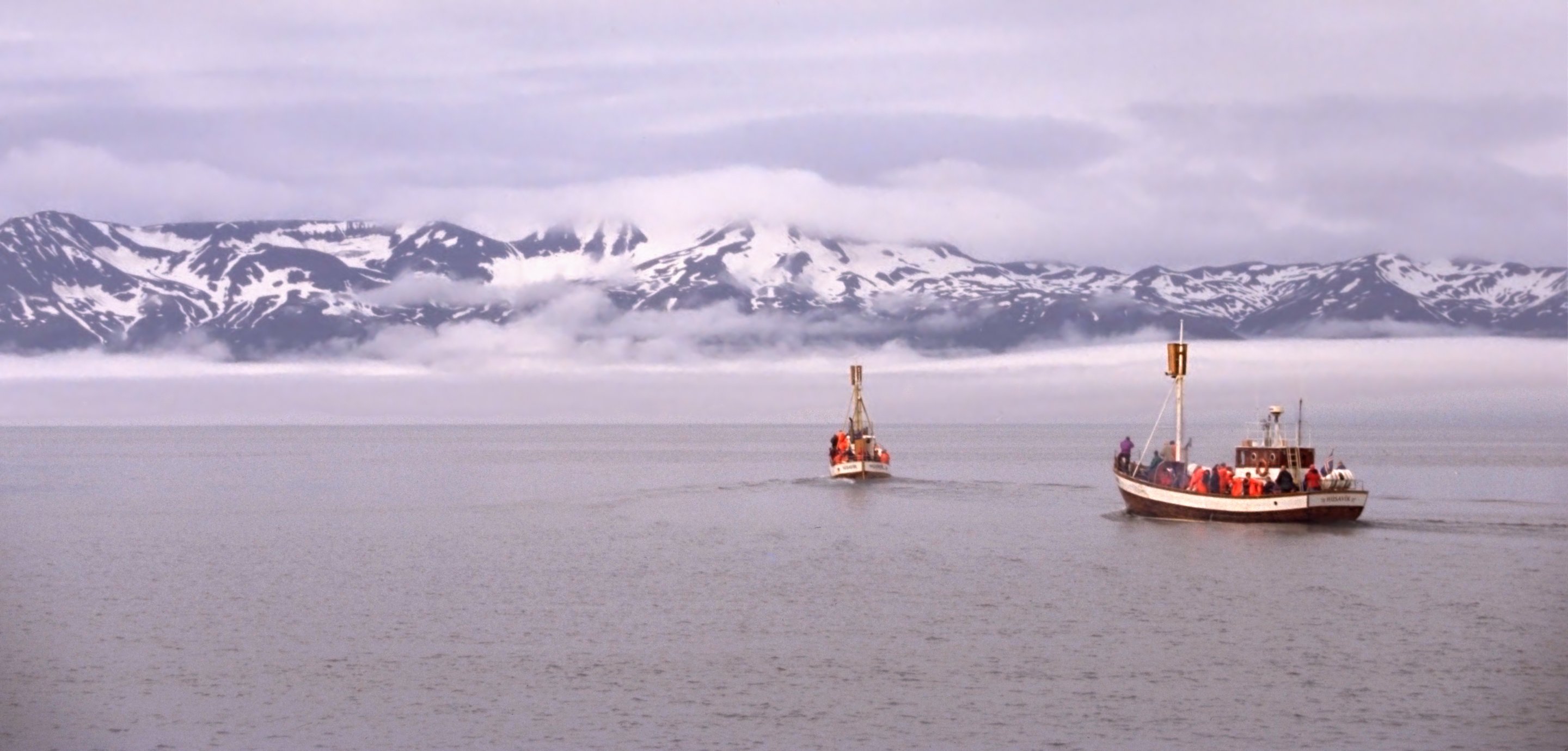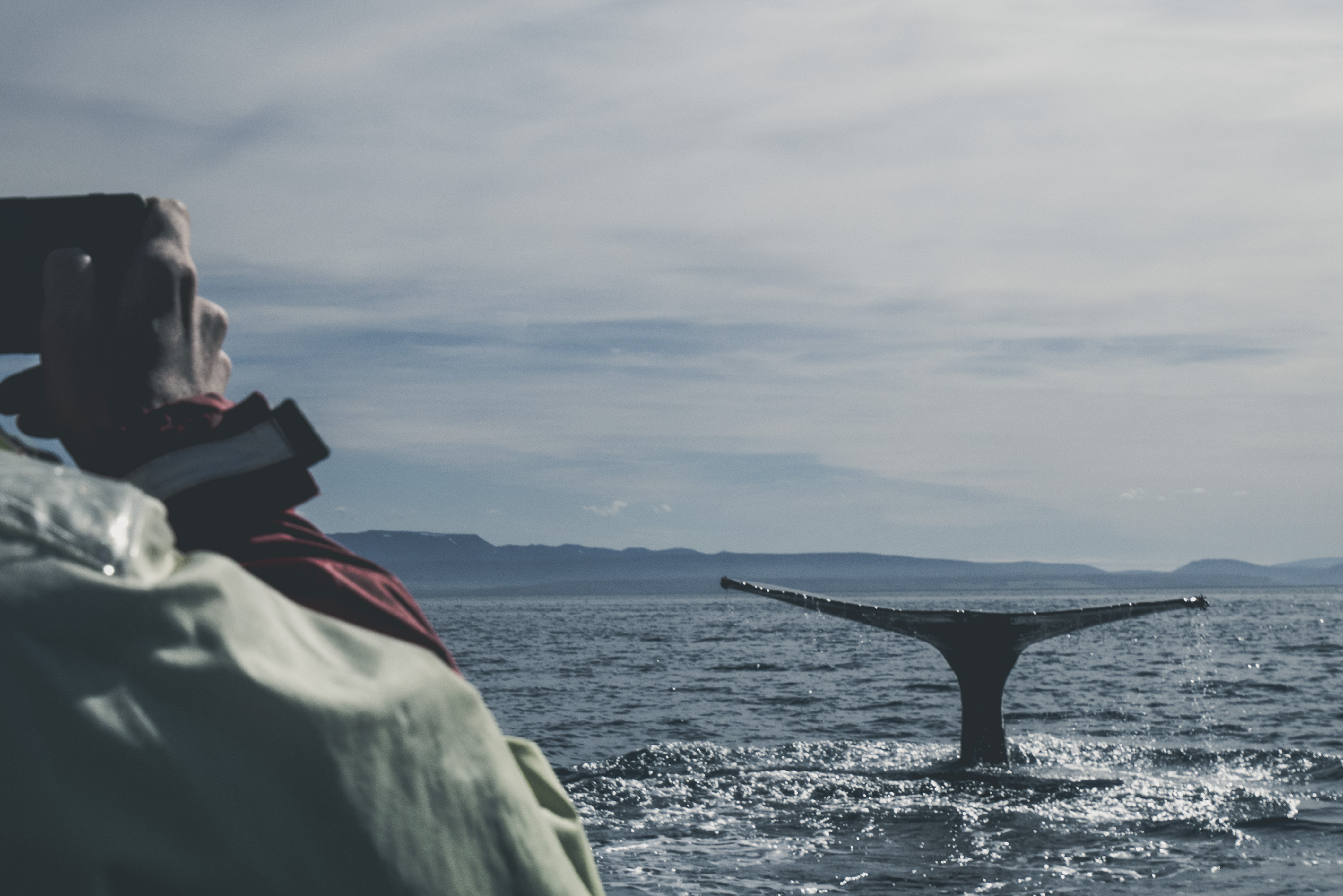
Húsavík sits on the edge of Skjálfandi Bay, a wide, cold inlet on Iceland’s north coast where the sea floor drops sharply enough to concentrate the prey fish and krill that large whales depend on. That geography is why this town of roughly two thousand people has become one of the most reliable places in Europe to see cetaceans from a boat. The whales are not a spectacle arranged for tourists. They are here because the bay feeds them.
Why it’s worth the trip
Reliability matters when you are travelling with limited time. Many whale-watching operations around the world sell hope. Húsavík, during the peak summer months, sells something closer to a near-certainty. Humpback whales are the main draw: large, acrobatic animals that breach, lob-tail, and surface close to boats with what feels like indifference to human attention. Minke whales are smaller and faster, surfacing briefly, but they appear frequently too. White-beaked dolphins and harbour porpoises show up often enough to be worth mentioning. On rarer occasions, blue whales have been spotted in the bay, which is a serious claim for any whale-watching destination.
Beyond the boat tours, the GEO Ocean & Whale Museum (formerly the Húsavík Whale Museum) gives the experience a second layer. It is one of the better natural history museums in Iceland, with full whale skeletons suspended overhead and serious interpretive content about cetacean biology and conservation. Spending an hour there before or after a tour changes how you process what you saw on the water.
Húsavík is also, frankly, a pleasant town. The harbour is working and modest, not a theme-park version of a fishing village. The wooden church on the hill above the waterfront is photogenic from almost any angle and visible from most of the bay. There are good cafes and a small but functional infrastructure built around the tourism trade without being consumed by it.
How to get there
Húsavík is roughly 75 kilometres northeast of Akureyri, Iceland’s second city, and the drive on Route 85 takes around an hour depending on conditions. From Akureyri, the road skirts the eastern shore of Eyjafjörður before turning toward the Þistilfjörður coastline and eventually Skjálfandi Bay. The landscape along the way is open, occasionally stark, and gives you a real sense of the north before you arrive.
If you are driving the Diamond Circle, Húsavík sits naturally between Mývatn to the south and Ásbyrgi canyon to the east, so it pairs logically with those stops without needing to be forced into a sequence.
There is no direct bus service that makes Húsavík easy to visit without a car, though scheduled coach services do connect Akureyri to Húsavík in summer. Check current timetables rather than assuming frequency. Most visitors arrive by rental car, which gives the flexibility to wait out weather or take a second tour if the first was disrupted.
What to expect on arrival
The harbour is small and easy to navigate on foot. The whale-watching companies operate from the waterfront, and their offices are visible without much searching. There are several operators, which means some choice in vessel type: traditional oak schooners, which are slower and quieter; rigid inflatable boats, which are faster and more exposed; and larger conventional tour vessels. Each has trade-offs. The schooners are atmospheric and gentler on those prone to seasickness, but they cover less distance per hour. The RIBs can close distance quickly but provide no shelter, which matters on a cold day.
A typical tour lasts around three hours. That includes the transit time out into the deeper water of the bay, the time spent with animals when they are located, and the return. Guides are generally knowledgeable and give commentary throughout. Most tours have a guarantee policy of some kind if whales are not sighted, though the terms vary by operator.
Dress warmer than you think you need to. Even in July, the wind on open water at 66 degrees north latitude is cold. Layers, a windproof outer layer, and warm footwear are sensible regardless of the air temperature onshore. Most operators provide overalls or flotation suits, and wearing them is worth it.
Seasickness is worth considering honestly. Skjálfandi Bay can be calm, but it can also have a significant swell, and three hours on the water in choppy conditions affects people differently. If you know you are susceptible, take appropriate precautions in advance.
When to go
The whale-watching season runs roughly from April through October, with June, July, and August representing the period of highest whale activity and most consistent sightings. Humpbacks in particular tend to be present throughout the summer in good numbers.
Spring offers the advantage of fewer tourists, which can matter for harbour parking and tour availability. Autumn is underrated: the light in September and October is different from the flat summer brightness, and the landscape around the bay takes on muted tones that some people prefer. The trade-off is more variable weather and shorter days.
Winter tours are not standard. The bay can be navigable, but whale presence is lower, operators often do not run scheduled departures, and the conditions are demanding. Do not plan a winter trip specifically around whale watching in Húsavík.
Visibility and sea state on any given day are impossible to predict far in advance. It is worth building at least one buffer day into a north Iceland itinerary if whale watching is a priority. Tours can be cancelled or delayed for safety reasons.
Tips and responsible-visitor notes
A few practical points worth noting before you go:
- Book ahead during July and early August. Tours fill up, particularly on good-weather days when demand spikes after several days of cancellations.
- Arrive at the harbour a bit before departure time to sort paperwork, collect any gear the operator provides, and get a sense of the briefing.
- Bring a camera with a reasonable zoom if photography matters to you, but accept that cetacean photography from a moving boat in open water is genuinely difficult. Many people find the experience more satisfying when they stop trying to document it.
- The Whale Museum is worth your time even if you have seen whales before. The skeleton of a blue whale is a different kind of encounter with scale than anything on the water.
On the question of responsible tourism: the operators in Húsavík work within Icelandic regulations on approach distances and vessel behaviour around whales, and most have been doing this for decades. That said, it is reasonable to ask questions about a company’s environmental practices and to choose operators who are transparent about them. The whale-watching industry here has a financial interest in the whales remaining healthy and present, which generally aligns with conservation, but that alignment is not automatic or universal.
Húsavík is not remote in any punishing sense. It is a real town with real services, a short drive from a regional airport, and a place where the thing it is known for actually delivers what it promises.