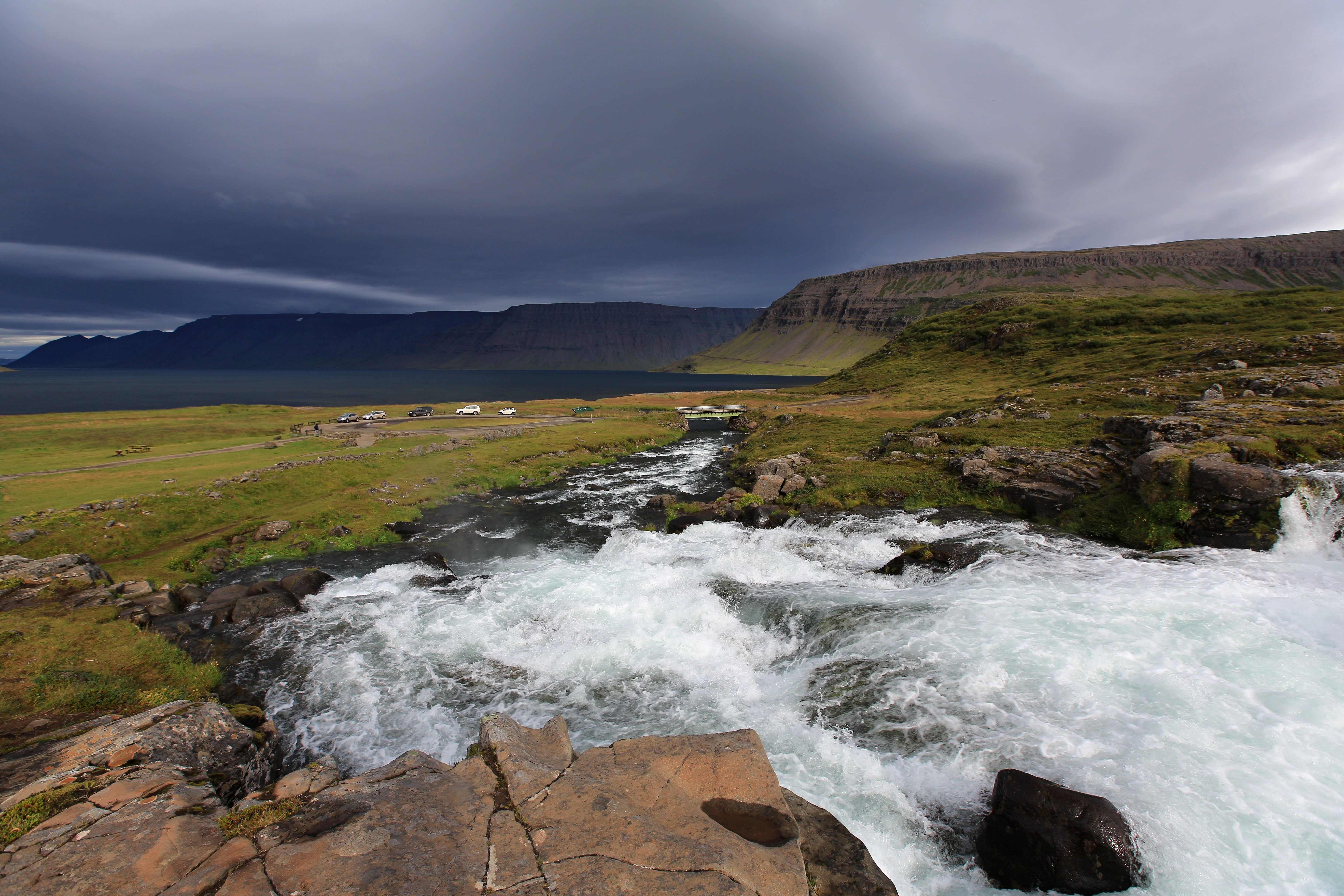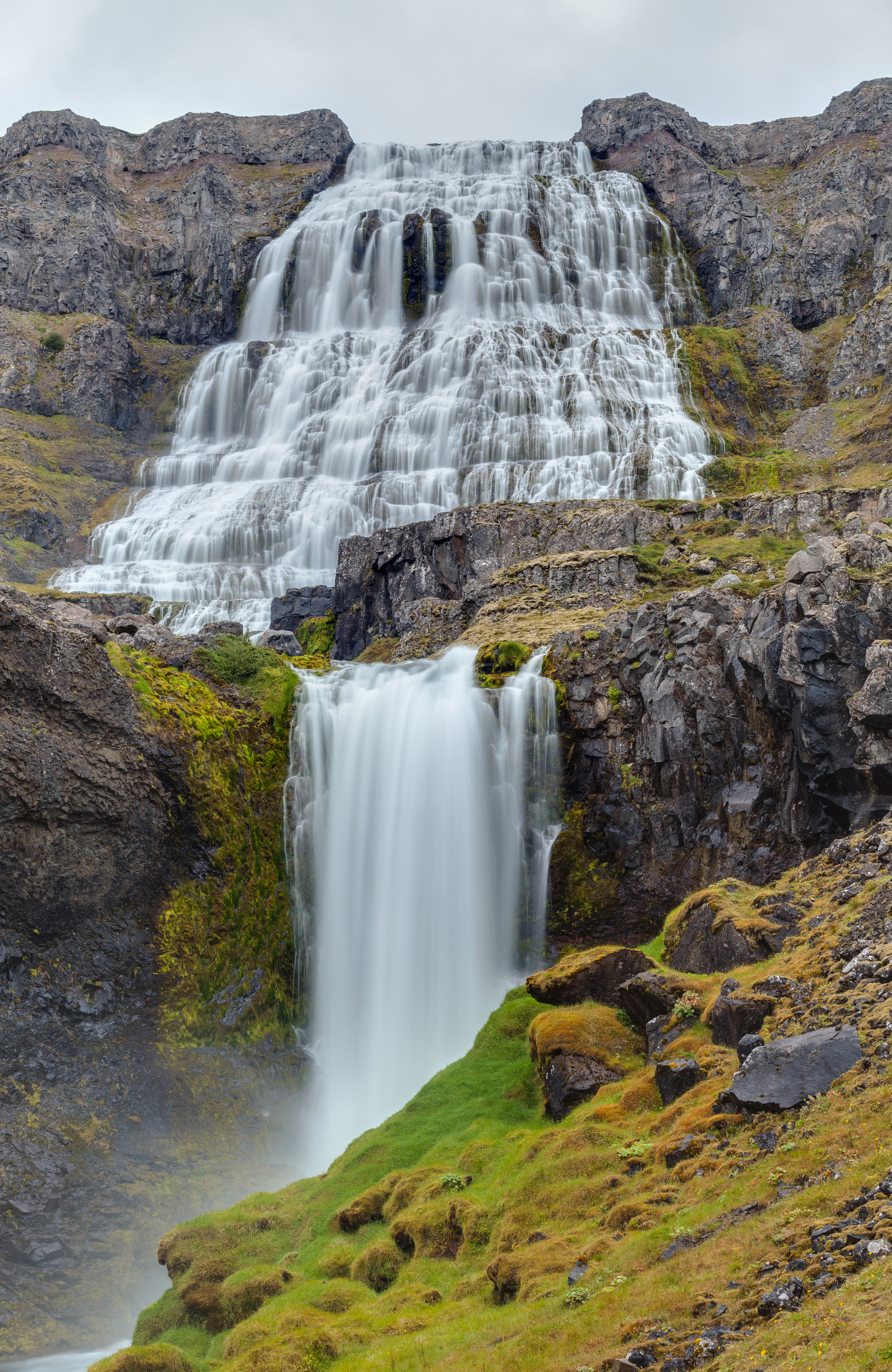
Dynjandi sits at the back of Arnarfjörður, one of the largest fjords in the Westfjords, and it announces itself long before you reach the car park. The white fan of water is visible from several kilometres away, spread across the mountainside like a drawn curtain. Up close, the scale makes more sense: the main cascade drops roughly 100 metres, widening as it falls so that the base is nearly 60 metres across. Below it, six smaller waterfalls step down through the same drainage, each named individually, though most visitors know the whole complex simply as Dynjandi.
Why it’s worth the trip
The Westfjords demands effort. Roads are long, services are sparse, and the region resists the kind of quick tick-box tourism common elsewhere in Iceland. Dynjandi fits that character. It is not a roadside stop. It requires a short uphill walk, and it rewards that walk with a physical encounter rather than a photographic one.
The sound is the first thing that changes as you climb. What begins as a distant hiss deepens into something more percussive, and by the time you reach the upper pool the noise is a genuine roar. The mist reaches you in waves depending on wind direction. On a calm day it settles on clothing and hair within minutes. The fan shape of the main fall is unusual even by Icelandic standards, created by the geometry of the basalt over which it spills. Water spreads outward as it descends rather than narrowing, which is the opposite of what most waterfalls do.
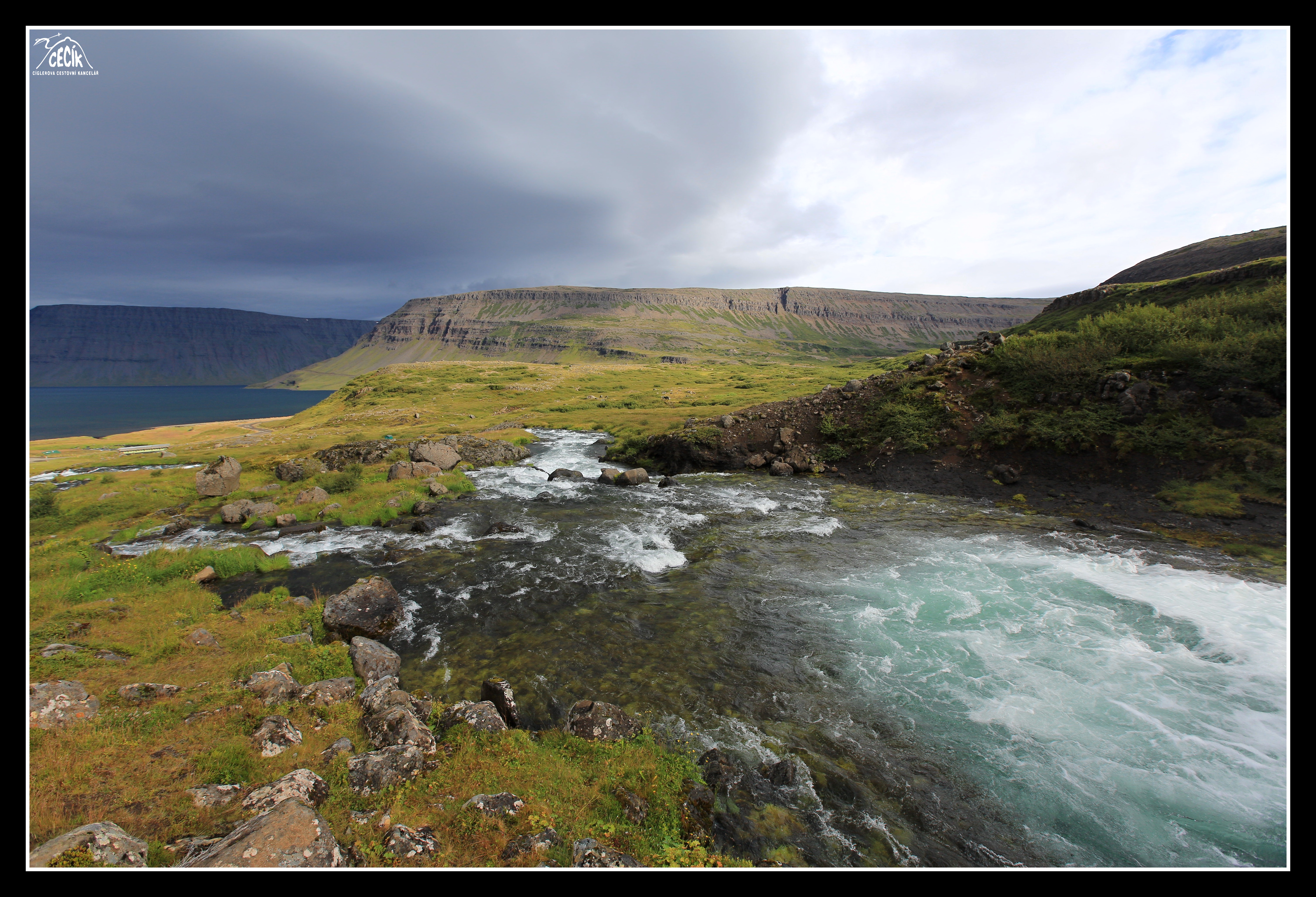
The fjord views from the upper section are a secondary reward. Arnarfjörður is long and relatively straight, and looking back down from the trail gives you a wide horizontal sweep of water and mountain that few spots in the Westfjords match from this angle.
How to get there
Dynjandi is reached via Route 60, which runs through the southern part of the Westfjords. From Ísafjörður, the regional hub, the drive takes roughly two hours on roads that include some gravel sections. From the south, approaching from Holmavik or via the ferry at Brjánslækur, the timing varies considerably depending on your starting point.
The road into Dynjandi branches off Route 60 and descends toward the fjord shore before ending at a parking area near the base of the waterfall complex. The access road is unpaved and follows steep terrain in places. Conventional two-wheel-drive vehicles can manage it in dry conditions, but the surface warrants care, and a higher clearance helps on rougher sections. Check road conditions through the Icelandic Road and Coastal Administration before travelling, particularly outside peak summer.
There is no public transport to Dynjandi. You need your own vehicle, or a place on an organised tour departing from Ísafjörður.
What to expect on arrival
The trail begins near the car park and follows a clear path uphill alongside the lower falls. The gradient is consistent but not severe, and the path is well-maintained for most of its length. Fit walkers in reasonable footwear will reach the base of the main fall in around 15 to 20 minutes. The full return walk, including time spent at each level, fits comfortably within an hour and a half for most people.
The lower falls each have their own character. Some are narrow and fast, others broader and shallow. The path passes close to several of them, and the rocks nearby are perpetually wet. Grip matters more than elevation here. Waterproof footwear is a practical choice rather than an overcautious one.
At the main fall the path ends on a flat area at the base of the cascade. There are no barriers between you and the water. You can stand close enough to feel the spray properly. The ground is uneven and damp. The viewpoint does not have a railing or a marked safety perimeter, which means it asks you to make reasonable judgements about where to stand, particularly with children.
The infrastructure at Dynjandi is deliberately low-key. Facilities exist but are minimal. There is no cafe or shop. Plan accordingly: carry water and something to eat if you are arriving after a long drive.
When to go
June through August gives the most reliable conditions. Snow has cleared from the access road by late spring in most years, and the falls are running at strong volume from snowmelt through early summer. By August the flow is somewhat lower but still substantial.
Visibility matters enormously here. On overcast days the falls remain impressive, but low cloud can shroud the upper section and eliminate the fjord views entirely. Clear days are rare enough in the Westfjords that when one arrives it changes the character of the place significantly. Light is generous in midsummer, which means early morning and late evening visits are genuinely possible and tend to be less crowded.
Spring, specifically May into early June, can be rewarding if the road has opened for the season. The snowmelt is at its peak, and the volume of water in the falls is higher than at any other point in the year. The trade-off is that access is less predictable, and weather is colder and more changeable. Autumn brings its own palette to the surrounding hillsides but also shortening days and an increasing chance of road closures.
Winter access is generally not possible without specialist local knowledge and equipment. The road can close entirely, and conditions around the falls themselves become hazardous.
Tips and responsible-visitor notes
Timing your drive matters in the Westfjords more than almost anywhere else in Iceland. Fill the fuel tank when you have the opportunity. Services thin out considerably between larger settlements, and the roads around Arnarfjörður are not somewhere you want to run low.
A few practical notes for the visit itself:
- Wear layered clothing regardless of the forecast. The microclimate near the falls is wetter and often cooler than the surrounding valley.
- The rocks along the path are slippery. This is not a warning about exceptional conditions; it is simply the baseline state of the terrain.
- Stay on the marked path. The hillside above and beside the falls is steep and unstable in places, and the vegetation takes years to recover from foot traffic off the trail.
- Bring a dry bag or a waterproof cover for cameras and phones. The mist at the top is heavy enough to soak unprotected equipment.
- The car park fills on busy summer days, particularly when tour buses arrive. Arriving earlier in the morning or later in the afternoon reduces the chance of sharing the upper platform with a crowd.
Dynjandi does not need embellishment. It is a large, loud, physically present waterfall at the end of a long drive through remarkable country, and the effort of reaching it is proportional to the experience of standing at its base.