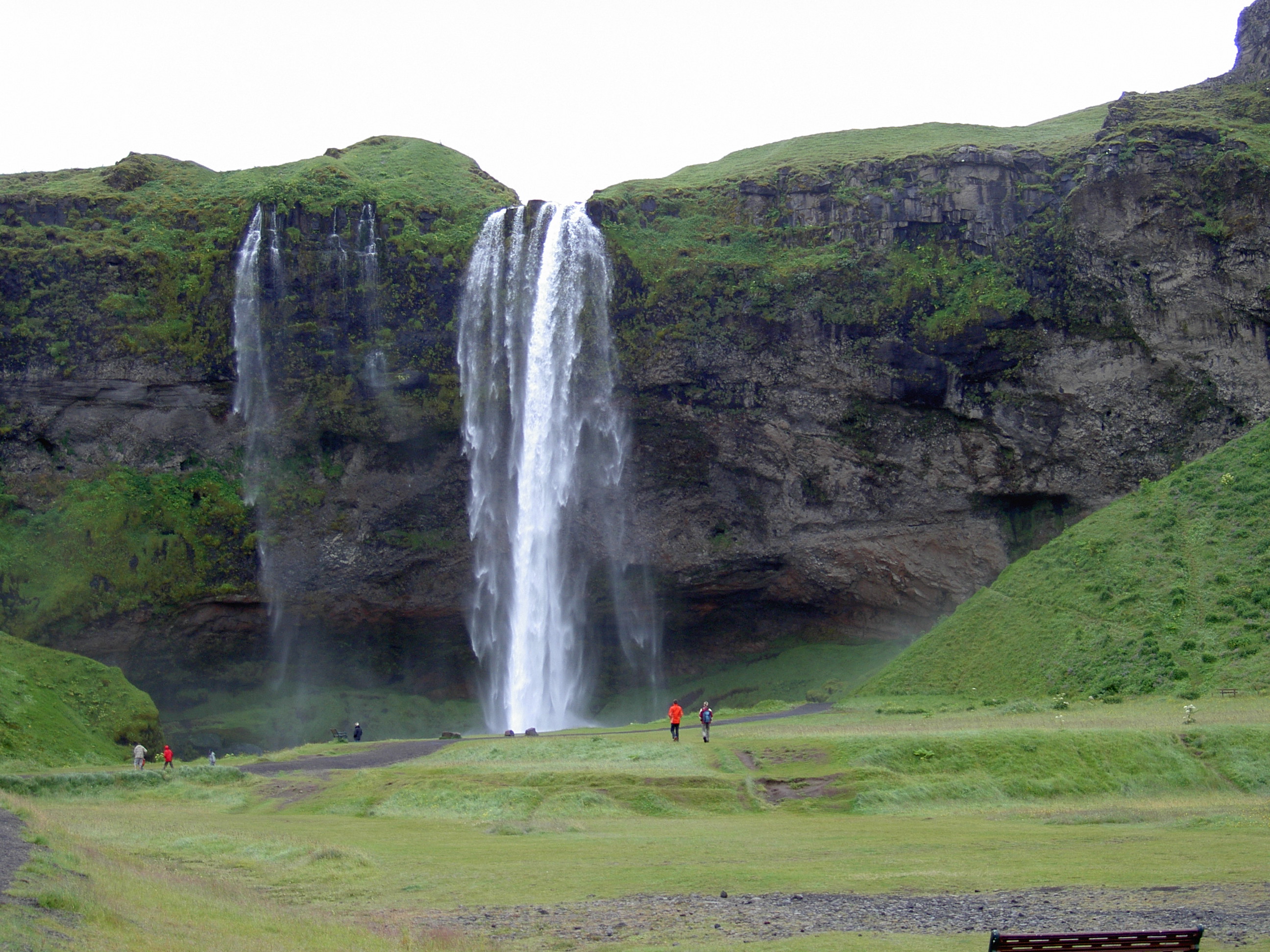
Seljalandsfoss drops sixty metres in a single curtain, and the river feeding it comes directly from the Eyjafjallajökull ice cap above. That geological fact alone makes this one of the more interesting waterfalls on the South Coast, but what draws the crowds is something more immediate: a narrow path runs behind the falling water, and for most of the year you can walk it.
Why it’s worth the trip
Most waterfalls reward you with a single viewpoint. You stand in front, feel the spray, take your photograph, and leave. Seljalandsfoss is different in structure. The waterfall pours over an old sea cliff, and erosion has carved a shallow cave behind the curtain. That recession in the rock is just wide enough for a footpath. Walking behind a large waterfall is unusual enough to stay with you in a way that simply watching one does not.
The loop path, which takes you from ground level, behind the water, and back around to the front, runs roughly 200 metres. It is short, but the change in perspective is considerable. From behind, the falling water becomes a translucent screen between you and the open valley, with the flat green farmland and the dark outline of Eyjafjallajökull visible through it. The effect is particular to the quality of Icelandic light, which is softer and more lateral than light further south, especially in summer.
The wider setting adds context. The South Coast here is wide and low, bounded by the glacier mass to the north and the Atlantic flat line to the south. Seljalandsfoss sits at the base of that glacial outwash plain, and on clear days the scale of the landscape behind the waterfall is part of what makes the stop worthwhile.
A note on a second waterfall nearby: Gljufrabui is a short walk further along the cliff face, largely enclosed within a gorge. It requires wading or careful boulder-hopping to see properly, and it is a distinct stop rather than part of the Seljalandsfoss loop. Worth knowing about if you have time, but not an automatic addition.
How to get there
Seljalandsfoss sits just off Route 1, the Ring Road, roughly 150 kilometres east of Reykjavik. The turnoff is well-signposted and easy to spot. A paved access road leads to a car park at the base of the falls. The drive from Reykjavik takes around one and a half to two hours depending on conditions and stops along the way.
If you are driving the South Coast as a day trip from the capital, Seljalandsfoss typically comes early in the route, before Skogafoss, Vik, and the black sand beaches further east. It pairs naturally with that corridor, but you do not need to combine it with anything. It stands on its own as a stop.
Public bus services do run along the South Coast, and stops near Seljalandsfoss are available on some routes during the summer season. Check current schedules before relying on this, as frequency and stop locations change between seasons.
What to expect on arrival
The walk from the car park to the waterfall base takes only a few minutes. The path to the rear is clearly worn and not technically demanding. The main physical challenge is moisture. The path behind the falls is exposed to significant spray, and in wet or windy conditions it becomes genuinely slippery. Waterproof clothing is not optional here. Waterproof footwear makes a real difference. The rock underfoot is often wet regardless of recent rainfall, simply from the constant mist the falls produce.
The path behind the waterfall is closed in winter, typically from around November through March, due to ice forming on the rock. Walking it in icy conditions has caused injuries. When the path is closed, the waterfall itself is still accessible from the front. A frozen or partially frozen Seljalandsfoss in winter light has its own character, but do not plan a winter visit around the behind-the-falls experience.
If you visit in summer and the path is open, go in the morning if you can. Seljalandsfoss is one of the more visited sites on the South Coast, and the car park fills steadily through mid-morning and into the afternoon during peak season. The path behind the falls is narrow, and passing other visitors requires care. Early morning visits give you both quieter conditions and better photographic light.
The spray radius at the base of the falls is wide. Anything you bring that cannot get wet should be protected before you approach. Camera gear is the obvious concern, and the spray can reach farther than it looks like it will from a distance.
When to go
Spring, summer, and autumn are the practical window. The access road and car park are generally open year-round, but as noted, the path behind the falls closes in icy conditions.
Summer brings the longest daylight and the most reliable path conditions. The midnight sun period, roughly mid-May through late July, means you can visit at unusual hours when the site is quieter and the light is extraordinary. Low evening sun hitting the spray of a large waterfall produces light that photographers specifically travel for. This is not a romanticisation of remoteness; Seljalandsfoss is on a main road and a busy one. But the light is real, and timing your visit to catch it costs only planning.
Autumn visits in September and October can be good, with lower visitor numbers than midsummer, though the path closure window approaches as temperatures drop. Spring from April onward sees snowmelt increasing the waterfall’s volume, and the surrounding landscape is in transition, which has its own visual interest.
Winter visits are possible but should be planned with realistic expectations. The path closure matters if that experience is the reason you are coming.
Tips and responsible-visitor notes
- Wear waterproof outer layers and waterproof footwear before you approach, not after you realise you need them.
- Keep distance from the base of the falls if there is any ice or frost on the cliffs above. Rock and ice do fall.
- The path behind the falls is narrow. Yield to oncoming foot traffic, especially where the path is most exposed to spray.
- Do not step off the marked path. The wet rock and grass around the falls erode quickly under foot traffic, and the vegetation here is recovering from years of heavy visitor pressure.
- Leave space in the car park for others. If the lot is full, wait or return at a different time rather than blocking the access road.
- Water flow and spray volume vary with season and recent weather. High snowmelt periods in spring produce a notably more forceful fall. If you visit after heavy rainfall, expect more spray and potentially slicker conditions on the path.
The total visit, including parking, walking to the falls, completing the loop behind the water, and returning to the car, takes around an hour for most people. It is a compact stop with a specific and memorable feature, and it delivers reliably when conditions allow.